Project Overview
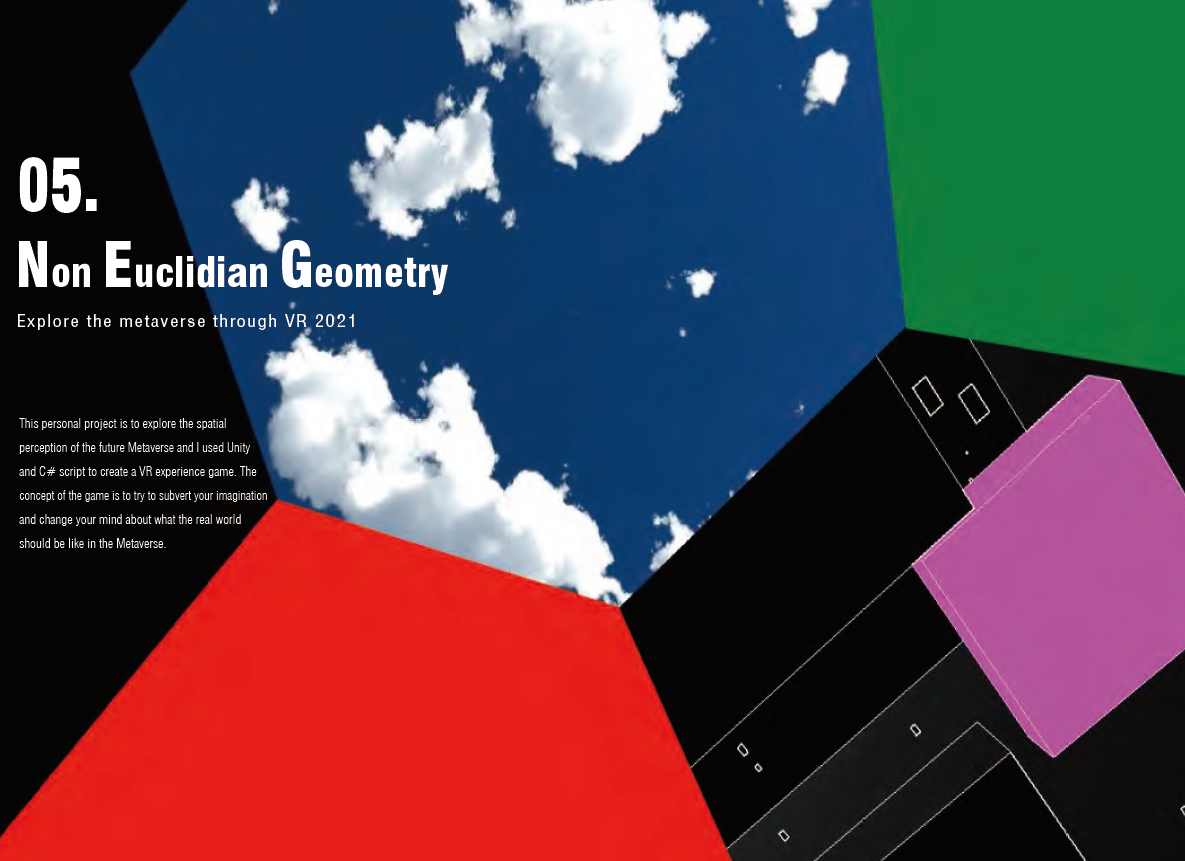
This project explores how non-Euclidean geometry — spaces that violate the usual rules of distance, angle, and dimensionality — can be constructed in VR to study spatial cognition, sense of presence, and navigation behavior. Inspired by architectural theory and impossible-space games (e.g., Portal, Antichamber), the environment uses connected portal-rooms and deliberate scale mismatches to produce experiences that feel physically impossible but remain navigable.
Developed in Unity / C# for HTC VIVE, the project formed part of early explorations into how XR can redefine spatial experience beyond physical constraints — a theme that carries into current research on XR-based spatial AI.
Key Features
- Portal-based room transitions: walking through an archway teleports the user to a spatially disconnected room rendered at a different scale.
- Scale mismatch: rooms appear small from outside but are vast when entered, exploiting VR's decoupling of visual and physical scale.
- Impossible corridors: hallways that loop back on themselves without the user perceiving the loop.
- Staircase Illusion: a continuous spiral staircase that always ascends yet returns to the starting floor.